
The Growlery

"Sit down, my dear," said Mr. Jarndyce. "This, you must know, is the Growlery.
When I am out of humour, I come and growl here."

Charles Dickens, Bleak House, Chapter VIII

Thursday, February 28, 2013

Literary Christmas Treats
Not this fall but last fall, I started composing a post about all the wonderful books and movies I enjoyed over the summer. Unfortunately my blogging ambitions are rather out of touch with grad school reality and the post was never more than a list of titles on a scrap of paper.

But some of those titles were really worth sharing and I was recently inspired by buying a friend some of my very favorite children's Christmas picture books. So I've decided to recast the list as a Christmas present recommendation/Year in Review list. As it's even a little late for Christmas now you can use it as a birthday shopping list in the new year and astound all your gift recipients with goodness -I'm willing to vouch for every item! As this represents two years worth of saving up, I've chosen two entries in each of 5 categories: 
                                                                         
1. Christmas Picture Books
2. Books                                                                                  
3. Movies                                                                                  
4. TV                                                                                  
5. Music

1.a The Great Wolf and the Good Woodsman by Helen Hooper, illustrated by Charles Mikolaycak 1967. (this is important--don't get the recent reprint with the horrible pictures!)


This has got to be my absolute favorite Christmas book ever (although I do have a real soft spot for this one too). The story is simple, yet moving. It's not religious yet it has some very biblical-feeling themes of the reconciliation of all things (Isaiah 11:6 stuff). It has the most beautiful illustrations, with a Russian fairy tale look. Imagine a Russian Little Red Riding Hood and you've about got the idea. Only instead of a girl, there's a woodsman with a fantastic red beard, and the wolf is well, more sympathetic and interesting. 

"It was Christmas, and the Great Wolf was very lonely. He was a mighty hunter, fleet of foot and sharp of tooth, and so he was feared by all animals in the forest."
 
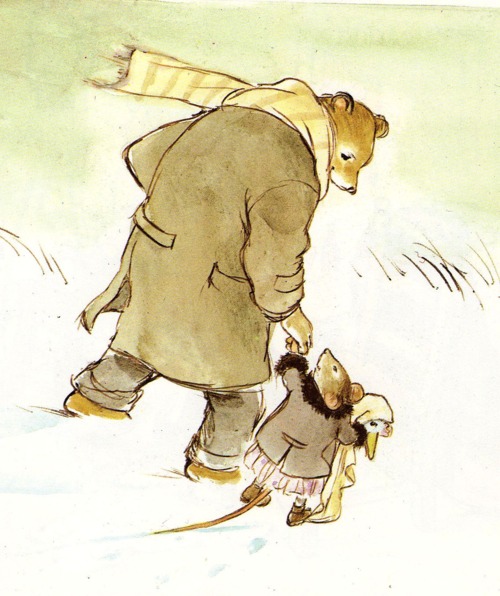
1.b Ernest and Celestine, by Gabrielle Vincent.


Just about the sweetest picture book you ever did see. Ernest, a bear, is the guardian of Celestine, a young mouse. No further explanation needed given their tender love for one another. Celestine loses her precious stuffed bird Gideon in the snow and Ernest clears out a toy shop to find a substitute to no avail. A very simple, understated story but with charming watercolor illustrations. There are a whole bunch of sequels but this one's the best. 


2.a Gilead by Marilynne Robinson

I've raved about this one before but it bears repeating. Reverend John Ames, an elderly minister writes letters to his young son since he expects not to live to see him grown. Seems like a simple story, but what with Ames' family history, which includes a wild abolitionist preacher grandfather, and the present which includes Jack, the questionably intentioned prodigal son of a fellow preacher who keeps hanging around town and annoyingly wants to talk theology, the tone quickly changes from elegy to drama. It's filled with so many beautiful images and moving passages it's hard to choose just one quote.

I can tell you this, that if I'd married some rosy dame and she had given me ten children and they had each given me ten grandchildren, I'd leave them all, on Christmas Eve, on the coldest night of the world, and walk a thousand miles just for the sight of your face, your mother's face. And if I never found you, my comfort would be in that hope, my lonely and singular hope, which could not exist in the whole of Creation except in my heart and the heart of the Lord. That is just a way of saying that I could never thank God sufficiently for the splendor He has hidden from the world - your mother excepted, of course - and revealed to me in your sweetly ordinary face. 

2.b Queen of Attolia by Meghan Whalen Turner


“This is the stupidest plan I have ever in my career participated in," Xenophon said. "I love stupid plans," said Eugenides.” 

And that in a nutshell is the character of Eugenides, or Gen, one of the most irresistible literary characters you'll ever meet. This book recommendation is really cheating a bit, since you must read The Thief, which introduces Gen and his world, prior to reading Queen of Attolia if you want to enjoy it at all. But what better tribute to a rascal like Gen then smoothly slipping an extra book into the list? This series is set in an alternate past that's sort of a late Medieval-Ancient Greek blend. There are gods, legends, and several clever plot twists. But by far the best thing is the vivid characters and dialogue, and this book, with its clash between Gen and the Queen of Attolia is the finest of the lot. I'd say more but I'd hate to spoil something so good.

“Please," he whispered. His voice was low but clear. "Don't hurt me anymore."

Attolia recoiled. Once, as a child, she'd thrown her slipper in a rage and had knocked an amphora of oil from its pedestal. The amphora had been a favorite of hers. It had smashed, and the scent of the hair oil inside had lingered for days. She remembered the scent still, though she didn't know what in the stinking cell had brought it to mind.”

3.a Of Gods and Men


This film tells the story of French Trappist monks living in loving harmony with their Muslim neighbors in Algeria who must decide whether to flee when the Algerian Civil War threatens their lives. I've heard this described as the best depiction of faith in modern cinema, and I have to concur: it sensitively captures the very human struggles to live in obedience to God. In addition it is gorgeously shot and has an appropriately contemplative pacing which serves to amp up the tension as the film moves towards its painful ending. The last supper scene, set to Tchaikovsky's Swan Lake is truly moving and feels like a Dutch painting come to life (the faces of the monks are illuminated against dark backgrounds). I love when films allow you to focus on the beautiful faces of actors and really allow their characters to shine though, and this film does this perfectly.


3.b I've Loved You So Long


A heartbreaking love story between two sisters, that is to say, it plays out like some love stories--with one party pursuing emotional intimacy and the other withdrawing, with deep, unconditional love ultimately held out as the answer to suffering. There is some amazing acting from Kristin Scott-Thomas who portrays the sister recently returned from prison with a completely believable combination of hardness and brokenness. In addition to the delicate portrayal of emotion, this film also depicts the joy of family life and bonds in all its significant details. Bonus: get a glimpse of French country living that will make you want to buy a ticket there pronto--I  thought this depiction was unrealistic until I actually visited the French countryside last summer!


4.a Little Dorrit 


One of these days, post-gradschool, I will finish reading Bleak House and all the other Dickens that I haven't had time for. But in the meantime I'll enjoy BBC's recent Dickens productions like Bleak House (so excellent!) and Little Dorrit. Little Dorrit is a typical Dickens tale in terms of involving rags-to-riches and a convoluted conspiracy plot-line, but of course as always with Dickens it's the colorful and loveable characters which really draw you in. This production has an Amy with a wonderful, expressive face (she rated my interesting faces post), and some top-notch, moving acting by Russell Tovey, as the faithful John Chivery. If the economy has got you down, enjoy this tender love story and remind yourself that bank crashes and lost fortunes are not exclusively modern phenomena.


4.b Downton Abbey 


If it's not too hipsterish to say it--I loved Downton Abbey before it was cool to love Downton. As a result I have mixed feelings about recommending it now, particularly given the upsetting rumors I've heard of the ruthless treatment of beloved characters in later seasons (I've only seen all of Season 1). Nonetheless, there are so many good, loveable things about this show, I can't not recommend it.  The opening credits themselves are worth the price of admission, and it provides a foretaste of the upstairs/downstairs pleasures to be found in the series. Chief among the show's virtues are its lovely and interesting characters. Well, to be precise, there are some lovely, more 'interesting.' But who can help loving Bates, Anna, Mr. Carson, Daisy, Mrs. Padmore, Lady Sybil...?


5.a The Songs of Songs, Andrew Rose Gregory


In the Garden of Ein Gedi.

A lovely modern interpretation of the Song of Solomon. The Gregory Brothers are the folks behind Autotune the News (whose coverage of the US presidential debates and candidates was my favorite part of the election). Turns out their autotune skills result from some serious musical chops, and middle brother Andrew Rose Gregory takes the lead in this sensitive, jazz-folk version of the best bits of Song of Songs. Besides being a fan of their music, I'm a fan of what seems to be a really interesting, fun loving family--to see what I mean take in their Wiki Wars competition videos.

 
5.b If On a Winter's Night, Sting


Soul Cake

I had never taken in any Sting prior to this album but I really like this Christmas album--he takes some more obscure Medieval Christmas carols, folk songs, and lullabies and does some interesting things with them (mostly American folk style renditions). I believe in the liner notes he mentions wanting to capture the underexplored melancholy of Christmas, and with songs like Cold Song, The Snow it Melts the Soonest, and The Hounds of Winter, I'd say mission accomplished! 


Labels: , , ,

Sunday, January 13, 2013

Pity and Romantic Love

I recently finished Marilynne Robinson's Gilead. I rarely cry, even when genuinely moved by a book, so I was astonished to find myself tearing up on the subway (where I do my leisure reading these days) at the bittersweet beauty of the story. Lest this gushing make you suspect that you are in for Oprah Book-of-the-Month-type chaff, I appeal to authority: Gilead won the 2005 Pulitzer Prize for Fiction. In other words it's in the same class as To Kill a Mocking Bird and Grapes of Wrath. You should read it; savor it.                                     
                                            
One passage in particular struck me: 

It is one of the best traits of good people that they love where they pity. And this is truer of women than of men. So they get themselves drawn into situations that are harmful to them. I have seen this happen many, many times. I have always had trouble finding a way to caution against it. Since it is, in a word, Christlike.

I was struck by this because I have previously had occasion to ponder the relationship between pity and love. I have never been in love, but I dated someone who I pitied, and that emotion had a strong effect on me which I think was similar to love and could have grown into love. I was never blind to his faults, but he became more dear to me as I watched him struggle with his weaknesses. I was well aware all the tropes about women being hurt in by broken men who they intend to fix, but I chose to date him (in part) on the conviction that true, Christ-like love does not mean being blind to flaws or expecting perfection but having compassion for weakness. But when the relationship ended, it made me wonder whether I had been right about the role that pity ought to play in love.

Shortly after that I reread Lord of the Rings and was surprised to find pity in the love story of Faramir and Éowyn. Here pity is mentioned in the description of Faramir and Éowyn's first meeting and conversation in which Éowyn wishes Faramir to release her from the Houses of Healing:

The Lord Faramir was walking alone in the garden of the Houses of Healing, and the sunlight warmed him, and he felt life run new in his veins, but his heart was heavy, and he looked out over the walls eastward. And coming, the Warden spoke his name, and he turned and saw the Lady Éowyn of Rohan; and he was moved with pity, for he saw that she was hurt, and his clear sight perceived her sorrow and unrest."
... 
'What would you have me do, lady?' said Faramir. 'I also am a prisoner of the healers.' He looked at her, and being a man whom pity deeply stirred, it seemed to him that her loveliness amid her grief would pierce his heart. And she looked at him and saw the grave tenderness in his eyes, and yet knew, for she was bred among men of war, that here was one whom no Rider of the Mark would outmatch in battle. 
...
'Then quietly,  more as if speaking to herself than to him; 'But the healers would have me lie abed seven days yet,' she said. 'And my window does not look eastward.' Her voice was now that of a maiden young and sad. 

Faramir smiled, though his heart was filled with pity.   

When I read this passage it seemed to me that Tolkien was using the word pity in a broader way than its modern, primarily negative usage, which, given Tolkien's philology background, made me suspect an archaic definition of pity. This deserves a far more thorough investigation, but the entry in the OED seems to confirm this hunch. The OED records a transition in the word from a meaning that is more similar to a deeply felt compassion (with religious undertones, given its etymological relationship to 'piety') to a modern usage that implies "disdain or mild contempt for a person as intellectually or morally inferior." Clearly the latter type of pity would be a very poor foundation for romantic love, but the former might actually be a solid one. Does not love (in the long term) require one to be able to smile with a sort of fond pity on the foolishness of one's spouse?

In Faramir's case we see that he is a virtuous man (Peter Jackson's slanderous depiction notwithstanding) and that being "a man whom pity deeply stirred" is a positive attribute. Indeed, earlier in the book this characteristic is revealed in his interaction with Frodo and Sam; his sensitivity towards others stands in stark contrast his father's callous nature. However, as Éowyn perceives, this tenderness does not mean Faramir is weak, pity is a virtue which is compatible with his warrior identity. To summarize, Faramir's pity is a laudable emotional response to suffering which seems to prime him to act with compassion towards others. In other words, to love them.

Going on the evidence of this first meeting of Faramir and Éowyn, it would seem that love and pity (of the archaic definition, of course!) are very closely related: at the very least pity grows into love and perhaps at points is not even distinguishable from love. It seems that there are other examples of this in literature. At the moment I'm in the middle of Anna Karenina and pity comes up quite a bit. For example, Karenin, the jilted husband, is recorded to feel pity towards his wife, son, his wife's lover, but towards his newborn daughter (the product of his wife's affair) he had "a sort of special feeling, not only of pity but of also of tenderness. At first it was only his feeling of pity that made him turn his attention to the delicate little girl, who was not his child and had been so badly neglected during her mother's illness that she would certainly have died had he not taken care of her, and he did not notice himself how he grew to love her."

But this sort of simple model (pity --> love or pity = love) doesn't explain what the risk is in loving someone who you pity. If pity and love can/should be so naturally allied, then why the problem that Robinson mentions and that I experienced? Is it simply that it's normally okay to love some you pity but that sometimes people get unlucky and pity undeserving people who hurt them? Or is there something that is inherently wrong dangerous (because I agree with Robinson that it's not wrong) about loving where you pity?

For a solution to this I think we need to return to Faramir and Éowyn since a couple pages later Tolkien complicates things by using pity in what would seem to be a more modern sense. In this scene Faramir and Éowyn are having a little DTR in which starts off with the fun fact that that Éowyn was very recently in love with Aragorn. 
 
'I wished to be loved by another,' She answered. 'But I desire no man's pity.'

Eowyn, Shield Maiden
'That I know,' he said. 'You desired to have the love of the Lord Aragorn. Because he was high and puissant, and you wished to have renown and glory and to be lifted far above the mean things that crawl on the earth. And as great a captain may to a young soldier he seemed to you admirable. For so he is, a lord among men, the greatest that now is. But when he gave you only understanding and pity, then you desired to have nothing, unless a brave death in battle. Look at me, Éowyn!'
And Éowyn looked at Faramir long and steadily; and Faramir said: 'Do not scorn pity that is the gift of a gentle heart, Éowyn! But I do not offer you my pity. For you are a lady high and valiant and have yourself won renown that shall not be forgotten; and you are a lady beautiful, I deem, beyond even the words of the Elven-tongue to tell. And I love you. Once I pitied your sorrow. But now, were you sorrowless, without any fear or any lack, were you the blissful Queen of Gondor, still I would love you. Éowyn, do you not love me?'

I think it's not a stretch to say that this conversation is a contest between two competing views of pity. Éowyn's, which pridefully rejects pity as demeaning, and Faramir's, which categorizes the sort of pity he and Aragorn offer her as "the gift of a gentle heart." So far so good, since Éowyn's view and Faramir's view nicely map onto the modern and archaic definitions of pity that we have been discussing. 

But Faramir, although he defends pity, makes a clear distinction between his pity and his love. He esteems and would love Éowyn even were there no cause to pity her. His love for her would not be diminished by the fact that he would not be needed by her and could not pity her were she completely well and happy as queen.

This, I think, is the key to the puzzle. Everyone has elements of brokenness and sinfulness that they will never be able to escape. Loving where one pities is indeed essential to the Christian calling, and a part of romantic love. Waiting for someone who you will never have to pity is unrealistic in the extreme and being unable or unwilling to pity weakness in a partner is an unwholesome state of affairs that is unlikely to lead to marital bliss.   

But it is perilous to love where you pity because feelings of pity can be easily confused for love. They can cloak the fact that you do not actually admire the person, and would feel deprived of your role as healer/savior/enabler were the person completely healed of whatever spiritual or emotional afflictions they have. Faramir's test is a good one. Would you still love this person even were they completely whole and well, and did not need you to become so?

Even with the risk, I believe in loving where you pity, because in the real world we cannot jump to healing on our own. Ultimate healing is unattainable in this world, yet even human love has a capacity for healing, and two broken people can be a source of healing for each other. I think Tolkien agrees with me because this is how the story of Faramir and Éowyn ends (post DTR and post kissing):

And to the Warden of the Houses Faramir said: 'Here is the Lady Éowyn of Rohan, and now she is healed.'


P.S. 
In case this post was too serious:


If you don't get the joke then it's time for a little JRR read/reread!

Labels: , , ,

Sunday, April 03, 2011

Interesting Faces

My sister and I collect what we call 'interesting faces'. We point out people that we see at events or on the street to each other: "Did you see that girl's face?" "Yup, I saw. So awesome." Recently during intermission at a concert I waited, craning, for several minutes for a gangly teen boy whose face Krista had proclaimed interesting to turn around. I never did get more than a glimpse.

Amazingly, Krista and I have a high rate of agreement despite never having laid out rules or guidelines about what constitutes an interesting face. Instead we seem to have an intuitive recognition of such faces. For example, while watching the Band of Brothers miniseries, we were both entranced by the face of a young soldier in the opening credits.


It wasn't until several episodes into Band of Brothers that one of us mentioned 'the soldier with the interesting face', and we both knew exactly who was meant, to the astonishment of the rest of the family. You can see him in the foreground at ~1:49-1:52. As you can see there are a whole lot of soldiers in the intro, most of whom have very pleasing, interesting faces, including, in the background of the very same shot, Damien Lewis, the actor playing the main (awesome) character Lt. Winters.


In fact, I think Lewis also fits into 'interesting face' category, and that most really good movies have a wealth of actors with interesting faces, but but more on that later. What I want to know is how exactly is it that Krista and I both identified the same anonymous young soldier as having an interesting face? What exactly constitutes an interesting face?

Let's take a look at a couple examples of actors and actresses whose faces Krista and I agree are interesting and see if there are any commonalities.


Honeysuckle Weeks


Rosamund Pike


Stephen Campbell Moore


Joanne Froggatt


James McAvoy


Romola Garai


Joseph Gordon-Levitt


Leelee Sobieski


Anthony Howell


Anne-Marie Duff


Simon Wood


Claire Foy

I notice a couple commonalities here. Deep set 'squinty' eyes are common. The men tend to have good strong noses, and the women to have wider cheekbones or rounder faces than are typically considered the ideal. But that doesn't get us very far.

Being actors and actresses they are of course a good looking bunch, with nice symmetrical, regular features. In fact, you might reasonably ask if Krista and I don't have a taste for people with interesting faces, so much as we have a taste for people with beautiful faces (which although totally natural is not particularly worth investigating).

However, consider the many beautiful people who don't make the interesting faces cut: actresses like Keira Knightly, Megan Fox, Penelope Cruz, Julia Roberts, Scarlett Johansson, Jennifer Lopez, Natalie Portman, Catherine Zeta-Jones, or actors like Brad Pitt, Tom Cruise, George Clooney, James Franco, Matthew McConaughey, Patrick Dempsey, Jude Law, and Jake Gyllenhaal.* Conventionally good looking I'll grant you (for most of them); interesting faces, not so much. Women in this sample tend to have thin oval faces with pronounced cheekbones and large eyes. The men vary a bit more but all seem to have some 'rugged' features such as a craggy brow and the traditionally strong jaw expected of a leading man. For an exemplar for these types consider Jon Hamm and January Jones of Mad Men fame.


See what I mean? Rugged good looks for Jon and a thin oval face with cheekbones for January. Given that they were cast to exemplify 1950s male and female beauty, I'd say that they do a pretty amazing job demonstrating the beauty ideals of today. But these ideals are rather boring if you ask me, so perhaps what we mean by beautiful faces is that they are beautiful faces that don't fit the cultural standard of beauty: too angular a face, too prominent a nose, too light of eyebrows, too round a face.

So Theory 1 for the existence of our 'interesting' categorization is reaction. Krista and I are reacting against the dominant and rather unimaginative standard of beauty, attempting to broaden the definition. For example our affection for rounder faces might be a reaction to the widespread favoritism for women with oval faces. If you need proof of this trend just check out this Justin Beiber music video -- they cast a girl with a thin, oval face as Justin's love interest in spite of the fact that the girl's sidekick has a way more interesting round face. You can catch glimpses of this girl (wearing white) at second 13, 16, 20 (and throughout the video, but I assume that you don't want to watch any more of it than you have to). Another piece of evidence in favor of this theory is the fact that many of the actors and actresses we consider interesting come from foreign films or period dramas--two venues that are also relatively reactive to the dominant culture's trends and beauty standards.

Or perhaps it's not that intentional, perhaps Krista and I, in our small community, have simply developed a consistent taste for a particular look.


If so, we wouldn't be the first. Take a look at the above photo of Sam, Milner and Foyle from Foyle's War (that is to say Honeysuckle Weeks, Anthony Howell and Michael Kitchen). Note that they all have similar faces, in particular, deep set 'squinty' eyes. Foyle's War is another prime location for finding interesting faces, but the actors often share have these similar eyes, including Foyle's son Andrew, not pictured here. But the three pictured above are not supposed to be related to each other, so I think what has happened here is that the director or casting agent (or both) has developed a taste for people with squinty eyes. So Theory 2 is a the development of a local aesthetic.

Or, Theory 3, perhaps we imprinted on people with round faces with squinty eyes.


Take a look at this picture of Krista and me, and you can probably spot a motive for wanting to elevate the squinty eyed, round face beauty ideal. Perhaps in finding these interesting faces we've actually been seeing and being attracted to resemblances to ourselves and our family.

But I tend to favor Theory 4, that we're really on to something here and have had the luck to stumble upon the Platonic form of the beautiful.

----
*All very unscientifically selected from various 'hottest' and 'sexiest' lists floating around the Internet.

Labels: ,